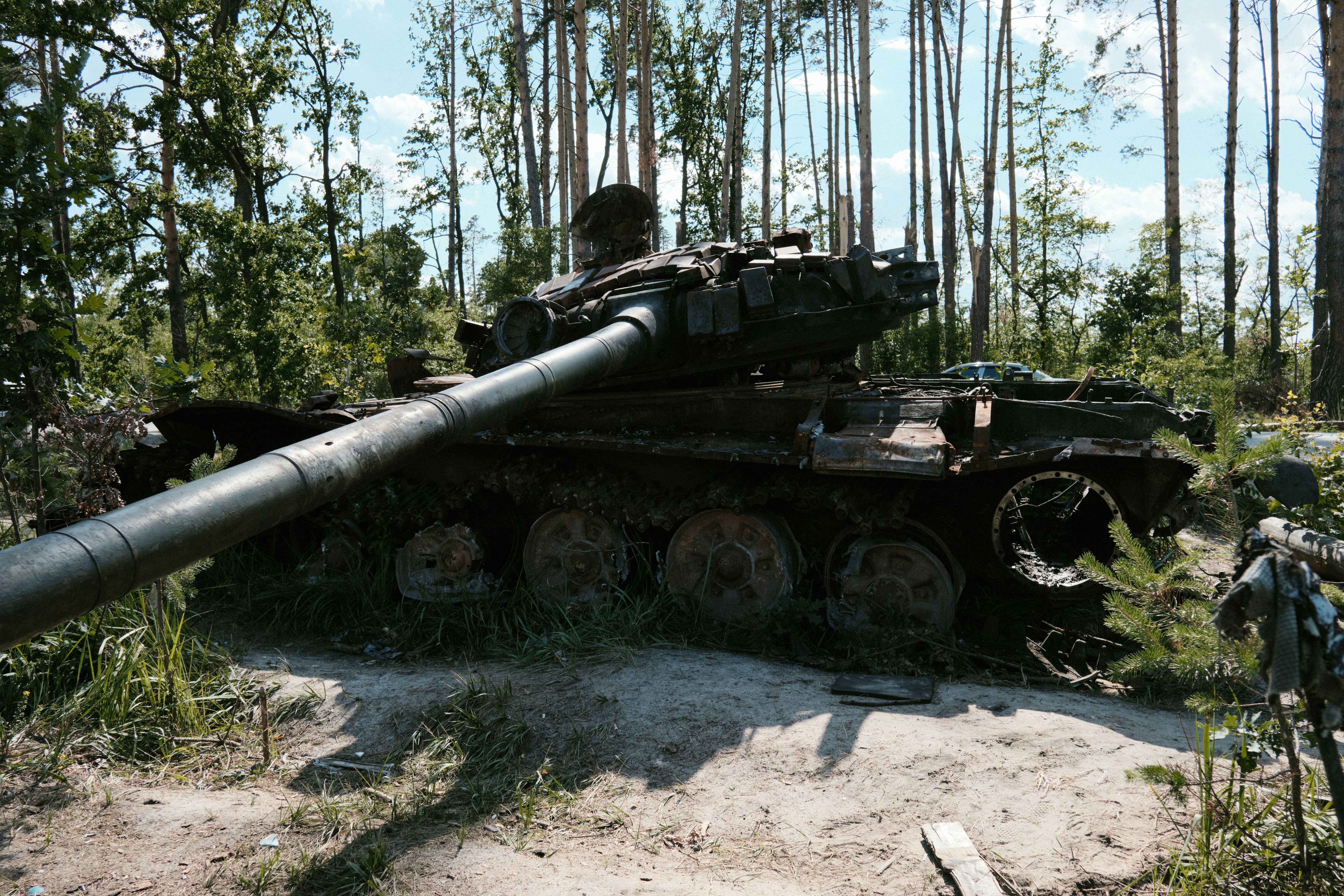
As technology accelerates, the traditional markers of military power are losing their edge. Today, a handful of drones costing around $35,000 each can neutralize systems worth millions. Conflicts are increasingly decided by manufacturing and by who can adapt fastest, not by who owns the most expensive hardware.
Canada now stands at a crossroads. It can keep measuring itself against the way military superpowers have structured their forces, or it can chart its own path. The United States remains dominant and Ukraine has shown how quickly warfare can change, but Canada should not adopt either model wholesale. It should build around its own strengths, discard outdated assumptions and design a force for the next conflict rather than the last one.
What cheap drones changed
Ukraine has shown that modern technology has levelled the playing field between militaries far more than anyone assumed. Air forces, navies and conventional armies still matter, but large, expensive assets are far more vulnerable to cheap, adaptable drones than planners expected. Russia began its invasion with a traditional approach centred on tanks, heavy artillery, armoured vehicles and massed troops, yet it has not been able to win decisively. The fighting has shifted toward drones as a primary weapon.
The war has become an innovation race. Both sides constantly update their drones, from thermal targeting to fibre-optic guided FPV drones that cannot be jammed. Soldiers’ equipment has changed too: both armies have moved toward modular kits built around counter-drone tools, electronic warfare devices and better protection against fragmentation. Adaptability, innovation and manufacturing now decide military strength.
The United States is learning the same lesson. The U.S.-Israeli war with Iran, which began on February 28, has shown how expensive it is to defend against cheap drones. Modern air defence systems were designed to stop rare, high-value threats, not swarms of low-cost, mass-produced drones. Iran’s Shahed drones cost around $35,000, while the Patriot missiles used to intercept them cost an estimated $4 million each. Even when the defences work, the cost exchange is unfavourable: defence costs far more than offence.
Why buying jets will not fix it
These lessons land at a critical moment for Canada. The country must redefine its military to assert control over the North and to deter pressure from its southern neighbour and other foreign actors. Decades of neglect toward the Canadian Armed Forces can fairly be called a major failure, but dwelling on past mistakes will not change the strategic reality. This moment should be treated as an opportunity to rebuild a force suited to modern conflict.
It is tempting to believe that one purchase of advanced fighter jets or other high-end platforms can rebuild a military. That is a short-term fix to a long-term problem. Buying the latest technology from other countries is counterproductive when it becomes the strategy rather than the foundation. Military technology moves on an exponential and unpredictable curve, which makes long-term reliance on foreign systems both costly and fragile. Without investing in its own industrial and research base, Canada will end up back at the same crossroads, once again dependent on expensive foreign technology to stay relevant.
Designing for the next war
Rather than mirroring the force structures of larger allies, Canada can deliberately move away from outdated models. By focusing on adaptability, modular systems, domestic production and rapid iteration, Canada can build a force that is resilient and affordable instead of one that is always chasing the next expensive platform. Building emerging technology, flexible doctrine and scalable manufacturing in from the start would let Canada align its military with how conflicts are actually evolving, and adapt faster instead of playing catch-up.
Canada’s advantage
Canada must use its strengths. It holds deposits of most of the critical minerals that modern military production depends on, and it produces 10 of NATO’s 12 defence-critical raw materials. It still lacks the refining and processing capacity to turn those deposits into a self-sufficient supply chain, but closing that gap would give Canada real leverage, because these materials are a chokepoint for modern technology and, by extension, military capability. Canada also has the most educated workforce in the G7. There is little reason it cannot become a more serious military power. Doing so would strengthen its ability to defend its sovereignty and give it influence over the materials that shape modern conflict.
Where to start
The priority should be adaptability, and adaptability has to be built. That means four things:
- Domestic supply chains for the materials and components the Canadian Armed Forces depend on.
- Sustained military research, tied to Canadian universities and industry.
- Industrial capacity to produce equipment at scale and at low cost.
- Procurement built for iteration, updating equipment continuously instead of making one large purchase every generation.
No one knows which technology will dominate the next war. A country that can design, build and update its own equipment does not need to know. That is the military Canada can afford, and the one it needs.

Leave a Reply